Reviews
2026 Hyundai i20 N


Price
Starting at $37,500 (excl. on road costs)
3 Things We Love
* The Old-School Hot Hatch Recipe * N-Specific Steering Wheel * N-Specific Bucket Seats
3 Things We Hate
* Stop-Start on a Performance Car * Wired CarPlay & Android Auto * Scratch-Prone Black Plastics
Intro
The 2026 Hyundai i20 N arrives with a bittersweet feeling. It has been around for a while now, but this final iteration marks the end of a small hot hatch recipe that is becoming increasingly rare. At just over $38,000 before on-road costs with the TTR package, the i20 N asks whether buyers should spend that money on something old-school, mechanical, and full of personality, or choose something more modern. Underneath, it sticks to the classic hot hatch formula: a 1.6-litre turbocharged four-cylinder engine, 150 kW, 275 Nm, a 6-speed manual gearbox, front-wheel drive, and a mechanical limited-slip differential.


Exterior
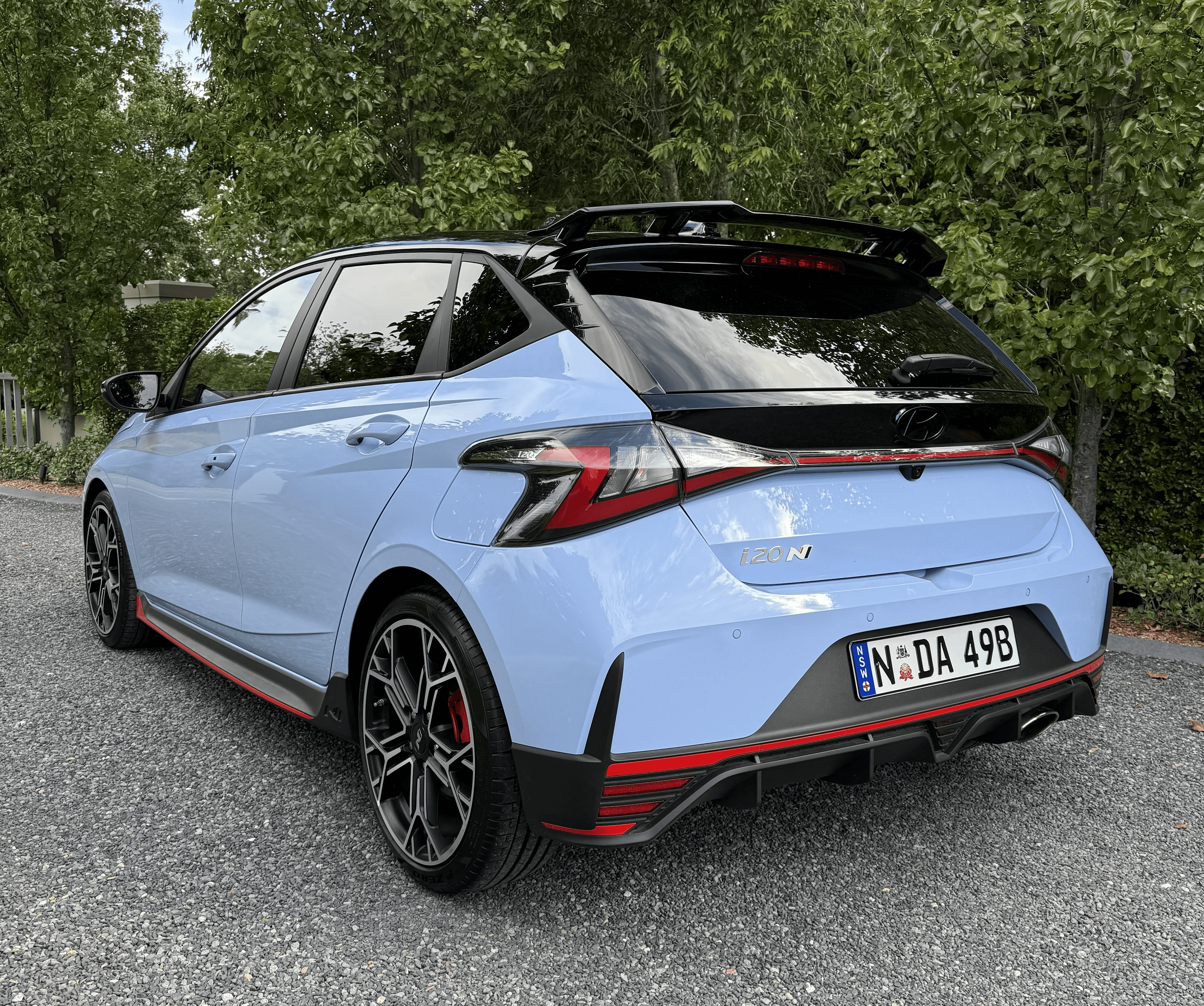
The i20 N has plenty of personality, and it is not trying to hide what it is. The design screams hot hatch, with red pinstriping around the lower body, a more aggressive front bumper, sharp angular lines, and Hyundai’s signature Performance Blue paint. Compared with the standard i20, the N gets LED headlights, a piano black front grille, 18-inch alloy wheels, aggressive side skirts with N badging, a rear spoiler, LED tail-lights, an aggressive rear diffuser, and a real single-exit exhaust. The aerodynamic pieces are not just there for show either, with the front splitter, side skirts, and rear wing helping reduce drag. The optional TTR package adds the black roof and mirrors, which is why this car comes in at just over $38,000 before on-road costs. Without that package, pricing sits at $37,500 before on-road costs.



Salvatore Gerace
MotorMarvel Journalist
Interior
Inside, the i20 N immediately feels special and driver-focused. The dashboard is angled toward the driver, the steering wheel feels thick and purposeful, and the large Performance Blue N buttons make it clear this is not a regular i20. Blue detailing appears throughout the cabin, including the air vents, shifter boot, gear knob, handbrake, bucket seats, stitching, and door cards. The touches are subtle enough to avoid feeling overdone, but strong enough to give the cabin personality. The trade-off is material quality. Hyundai clearly spent money on the performance upgrades, and the cabin plastics are where the cost-saving shows. The black plastic marks easily and feels cheaper than some buyers might expect at this price. Technology is solid, with two 10.25-inch screens, one for the driver display and one for the infotainment system. Both are clear and crisp, and the infotainment system is user-friendly with useful shortcut buttons. However, Apple CarPlay and Android Auto are wired, which feels disappointing when cheaper cars now offer wireless connectivity. Practicality is decent for a small hot hatch. There are usable door bins, cup holders, a glovebox large enough for a water bottle, a wireless phone charger, USB-A, USB-C, and a 12-volt socket. The manually adjustable bucket seats are comfortable and supportive, and they also help keep weight down. The second row is more usable than expected, with decent knee room, acceptable headroom, ISOFIX points on both outboard seats, and three top tether points. Two adults can fit, but three adults would be a stretch. There are also no rear air vents, which is a downside in hot Australian weather. Boot space is good for the size of the car, with 310 litres available with the second row up and just over 1,100 litres with the seats folded.


Specifications
Engine
1.6-litre four-cylinder turbo petrol
Power
150 kW
Torque
275 Nm
0 - 100 kph
6.5 seconds
Transmission
6-speed manual
Drive Type
Front-wheel drive
Fuel Economy (Claimed)
6.9 L/100 km
Fuel Economy (As Tested)
8 to 9 L/100 km
CO2 Emissions (Claimed)
158 g/km
Fuel Tank
40 L
Weight
Just over 1,100 kg
Vehicle Dimensions
Length
4,075 mm
Width
1,775 mm
Height
1,440 mm
Wheelbase
2,580 mm
On the Road
Day to day, the i20 N is firm, but that is part of the deal with this kind of car. The stiffened chassis and suspension mean it is not the most comfortable hatchback over rough roads, but it remains usable and not overly loud inside. The manual gearbox and clutch are major highlights. The clutch is light and predictable, and the gearbox is easy to use even in traffic. That makes the i20 N much easier to live with than some people may expect from a manual hot hatch. The car’s biggest strength is the way it feels. It has an old-school hot hatch character that many modern cars have lost. The short wheelbase, torsion beam rear axle, mechanical limited-slip differential, rev matching, and physical handbrake all work together to make it feel mechanical, playful, and simple in the best way. In N mode, the i20 N becomes properly entertaining. The steering feels well weighted, the chassis feels balanced, the limited-slip differential pulls the car out of corners, and the exhaust gives you pops and bangs on throttle lift and gear changes. There is some torque steer, but it is manageable, and it adds to the car’s personality rather than ruining the experience. The engine does lose some steam past 5,000 rpm, but the car is still quick enough. On paper, 0–100 km/h is 6.2 seconds, though the review suggests a more realistic range of 6.2 to 6.7 seconds depending on the shift, with around 6.5 seconds being a fair real-world figure.


Safety Tech
Safety equipment includes autonomous emergency braking, blind spot monitoring, lane keep assist, lane following assist, rear cross-traffic alert, rear occupant alert, reversing camera, front and rear parking sensors, and speed sign recognition. Some of the safety features can be annoying, but they can be turned off. The stop-start system is one of the bigger frustrations, especially in a manual performance car, where it can make quick take-offs from traffic lights feel awkward. Warranty coverage includes five years warranty, five years capped-price servicing, and 12 months of roadside assistance.


Our Verdict
The Hyundai i20 N feels like a farewell to a type of car that is slowly disappearing. As electrification and hybridization take over, small dedicated hot hatches like this are becoming rarer, and that makes the i20 N feel even more special. It is not perfect. It is firm, the cabin plastics are cheap in places, the infotainment lacks wireless smartphone mirroring, and the engine loses some energy higher in the rev range. But those flaws are easy to forgive because the car has so much character. At its core, the i20 N is old-school hot hatch fun: a small body, turbo engine, front-wheel drive, mechanical limited-slip differential, six-speed manual gearbox, rev matching, and a physical handbrake. It is simple, playful, and full of personality. For someone wanting a tiny hot hatch that can be used as a friendly city car during the week and a smile-machine on the weekend, the i20 N is a brilliant final send-off.
Overall Rating


